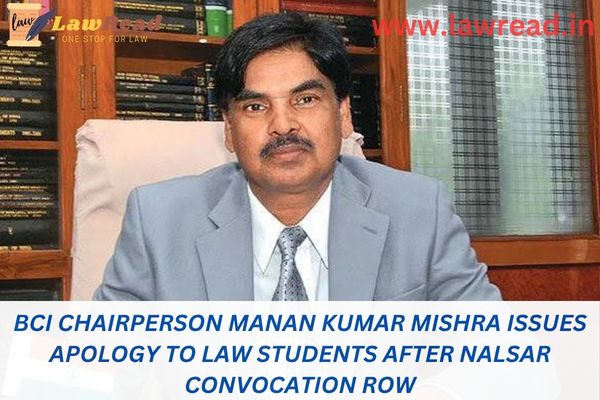
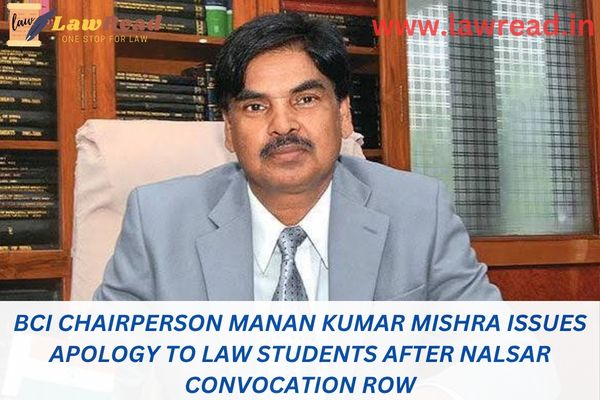
Following the NALSAR convocation dispute, BCI chairperson Manan Kumar Mishra apologizes to law students.
Students at NLSIU Bangalore and NALSAR University of Law in Hyderabad have criticized BCI's handling of the controversy surrounding CJI Surya Kant's attendance at NALSAR's 2026 convocation.
Mishra Manan Kumar
In a letter sent on Independence Day, Manan Kumar Mishra, the chairperson of the Bar Council of India (BCI), apologized to law students.
The apology comes after students at National Law School of India University (NLSIU) Bangalore and National Academy of Legal Studies and Research (NALSAR) University of Law at Hyderabad criticized BCI's handling of the controversy surrounding Chief Justice of India (CJI) Surya Kant's attendance at NALSAR's 2026 convocation.
The apology mentions previous events that he claimed had alarmed students, even if it does not specifically name the university or the disagreement.I truly regret and apologize if any of my remarks or letters related to the current topic have offended our law students. It should be said without hesitation. Expressing regret has nothing to do with ego or status. It's just a recognition that our children' emotions and worries are important," the statement read.
The dispute started on August 13, when the BCI ordered that enrollment for NALSAR's graduating class of 2026 be halted due to objections to CJI Surya Kant's attendance as the convocation's major guest. But within hours, the BCI overturned its ruling in response to criticism from the legal community.
Later, the Student Bar Council of NALSAR released a statement calling on Mishra to publicly apologize for BCI's handling of the incident. A similar demand was made in a joint statement by NLSIU's alumni, current students, and graduating students. Additionally, NLSIU students objected to the CJI and the BCI Chairperson attending their own commencement.
In accordance with this, Mishra went on to apologize today.
He praised National Law Universities (NLUs) students as some of the nation's most intelligent and astute young people, adding that their behavior and decisions are observed throughout the legal education system and frequently affect how students at other Centers of Legal Education (CLEs) perceive related issues.The young men and women enrolled there today will go on to become teachers, scholars, judges, advocates, and senior advocates in the future. Some of them might eventually hold the most senior roles in the judicial and legal systems. Because of this, their choices have implications that go beyond a particular incident or dispute, according to Mishra.
A constitutional democracy should allow for peaceful protest and debate, he said, but every subject should be "reconsidered objectively and with an open mind" as further information or clarifications become available.
Convocation is a unique event that is difficult to duplicate, according to Mishra, and it is ultimately up to the students to decide whether or not to attend.No student should feel pressured to skip class or be forced to attend. My only argument is that they ought to make the
decision on their own, after weighing all relevant factors and using their own discretion," he stated.
Additionally, he stated that the conflict should not be let to "acquire a political or extraneous color thru outside influence," and he urged a fair and reconciling resolution.
If the accused is served with a consolidated notice of demand, a single complaint for the dishonor of more than three checks may be maintained: The J&K&L High Court
Orissa High Court Shares Concerns About Data Breach & Privacy Violations While Upholding Mandatory PAN-Aadhaar Linking For Demat Accounts
The Supreme Court dismisses the case against a public servant, stating that S. 197 CrPC does not envision the concept of "deemed sanction."